A queue that grows faster than the team
Applications, onboarding requests and alerts arrive in volume, and each one needs reading, checking and an opinion. Hiring at the same pace does not add up.

AI flows for financial institutions
Ready-made Aptabit Platform templates for credit analysis, onboarding, document forensics, PEP screening and anti-money laundering. Adapt them to your policy, connect them to your credit pipeline and run everything on the institution's infrastructure.
Credit analysis, customer onboarding and anti-money laundering demand the same care at any institution. What changes is how many people are available to do it every day.
Applications, onboarding requests and alerts arrive in volume, and each one needs reading, checking and an opinion. Hiring at the same pace does not add up.
Income, debt, documents and account activity are protected by banking secrecy and data protection law. Sending them to an AI hosted by a third party creates a bigger problem than it solves.
Internal audit, external audit and the customer can all ask why an opinion came out the way it did. An answer with no recorded reasoning is not enough.
Each template becomes a draft in your workspace, already linked to the configured AI model. From there the flow is yours: change the instructions, fields, rules and destinations.
Assesses an individual's risk from income, debt and requested amount, and returns a recommendation, risk band, suggested limit and reasoning.
Credit opinion for companies based on revenue, debt and industry.
Extracts and validates declared income, flagging discrepancies.
Builds the collection schedule and message suited to the customer profile and the stage of the debt.
Extracts and validates customer data to open the relationship.
Looks for signs of tampering in data extracted from ID cards, driver's licenses and proofs of address.
Assesses whether a name or profile shows signs of being a politically exposed person or on a restricted list, and the associated risk.
Analyzes a transaction or alert and rates the money laundering risk, with the reasoning for the analyst.
Checks a text or process against a regulatory checklist and points out gaps.
Identifies and redacts sensitive personal data in a text.
Generates an audit report from events and findings.
Assesses a vendor's risk from the data provided and the knowledge base.
Extracts entries from a statement and flags discrepancies against the expected entry.
Extracts parties, amounts, terms and obligations from a contract.
Points out risky clauses in a contract and suggests changes.
Answers customers using the knowledge base, with a polite fallback when it cannot find the answer.
The template saves you the blank page. The fine tuning stays with the people who know the institution's policy.
One click creates the flow as a draft in the workspace, with the AI model already linked.
In the visual editor you change instructions, input fields and decision rules, and add lookups into internal manuals and policies.
Every published flow gets its own API endpoint and token. Your core system, credit pipeline or CRM calls the flow and receives a structured result.
Decision blocks separate what runs automatically from what goes to human review, with tracing and audit.
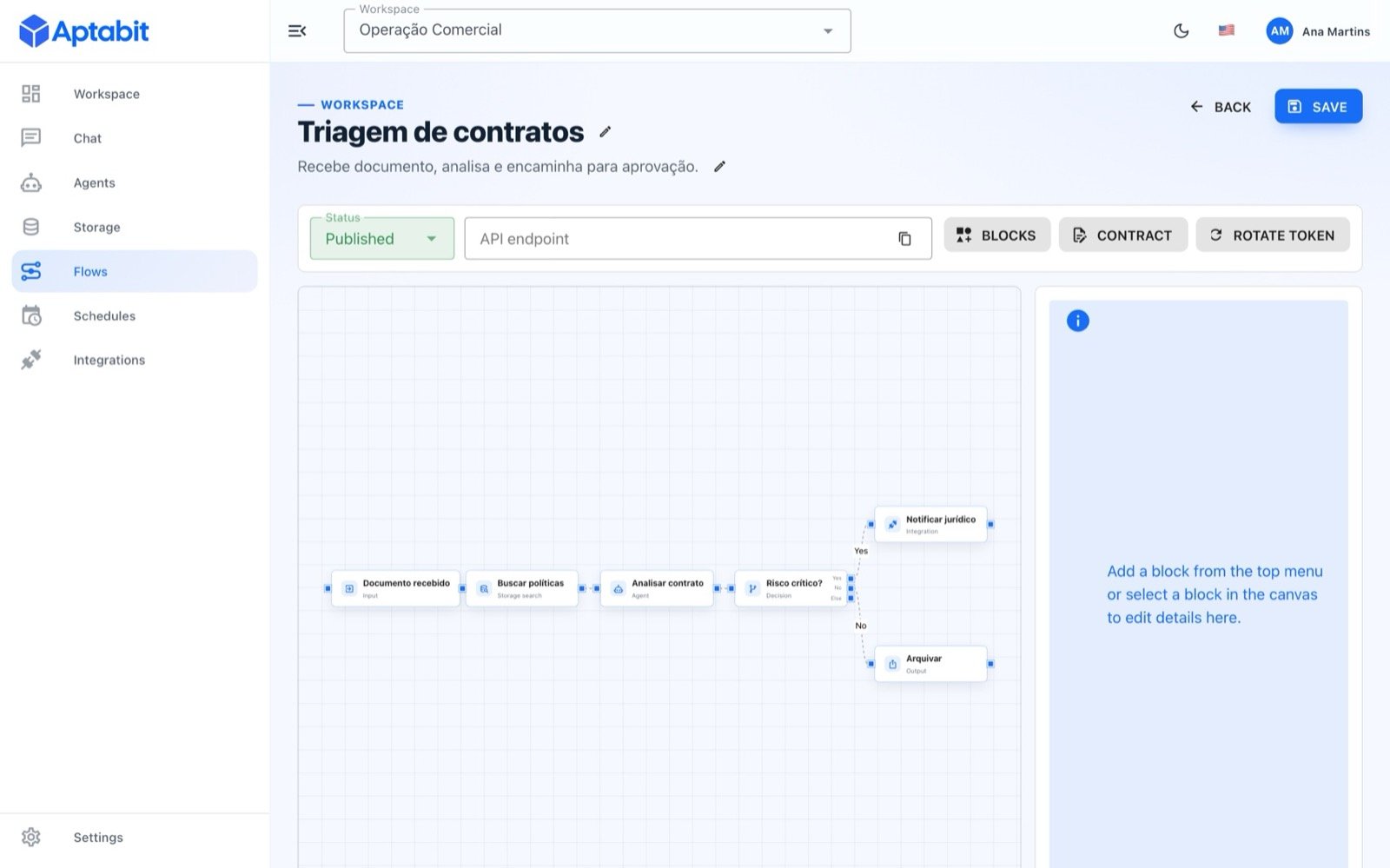
Aptabit Platform is installed in the institution's environment. A credit application does not need to pass through another company's cloud to be analyzed.
Docker, Kubernetes or on-premise. Database, files and vectors stay in your environment.
Run models with Ollama, vLLM or LM Studio, or bring your own key from a cloud provider.
Fixed license, no fees per analysis, token or user. More applications do not mean a bigger bill.
Isolated workspaces, roles, RBAC, ABAC and an audit trail.
No. Aptabit Platform runs on your infrastructure and, with a local model, inference happens there too. If the institution prefers a cloud model with its own key, that choice is its to make.
Only if the institution designs the flow that way. The templates deliver an opinion, a risk band and a recommendation with reasoning. What runs automatically and what goes to an analyst is set with decision blocks and human approval.
Yes. The template is a starting point. Policies, manuals and internal rules go into the workspace knowledge base, and the flow checks those documents before issuing its opinion.
Every published flow exposes an API endpoint authenticated by token. Your core system, credit pipeline or CRM sends the data and receives a structured response. HTTP, webhook and MCP integrations are also available.
Fixed license, with capacity limits set in the contract. There are no fees per analysis, per token or per user.
With a diagnosis of the process with the most volume or the most risk. Then we install the platform in your environment, put a first flow into a pilot and expand from the results.
Demo
Tell us what you want to automate first. The conversation starts with the process, not the tool.